

Values of Nature
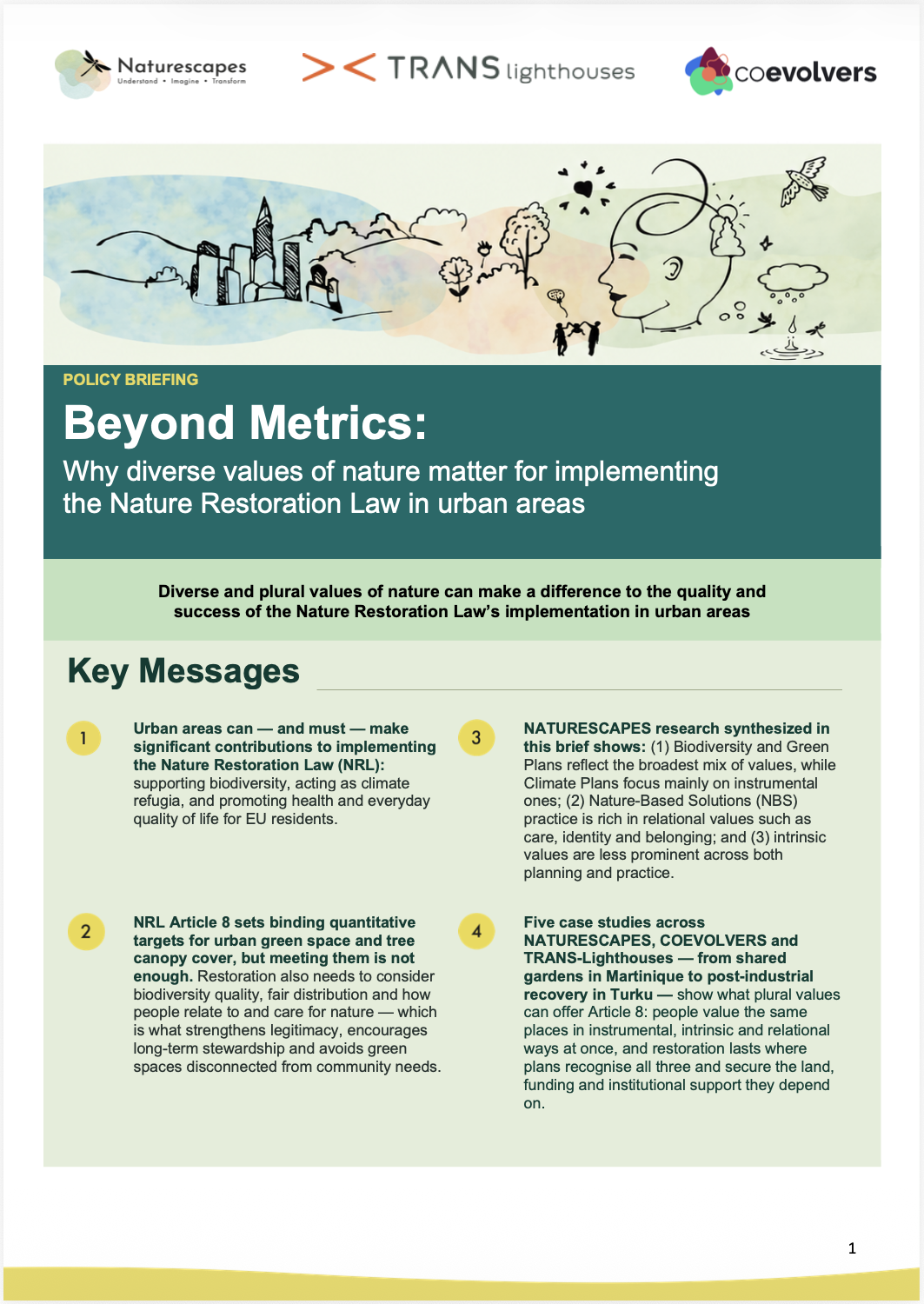
Beyond Metrics: Why diverse values of nature matter for implementing the Nature Restoration Law in urban areas
Key Messages
1. Urban areas can — and must — make significant contributions to implementing the Nature Restoration Law (NRL): supporting biodiversity, acting as climate refugia, and promoting health and everyday quality of life for EU residents.
2. NRL Article 8 sets binding quantitative targets for urban green space and tree canopy cover, but meeting them is not enough. Restoration also needs to consider biodiversity quality, fair distribution and how people relate to and care for nature — which is what strengthens legitimacy, encourages long-term stewardship and avoids green spaces disconnected from community needs.
3. NATURESCAPES research synthesized in this brief shows: (1) Biodiversity and Green Plans reflect the broadest mix of values, while Climate Plans focus mainly on instrumental ones; (2) Nature-Based Solutions (NBS) practice is rich in relational values such as care, identity and belonging; and (3) intrinsic values are less prominent across both planning and practice.
4. Five case studies across NATURESCAPES, COEVOLVERS and TRANS-Lighthouses — from shared gardens in Martinique to post-industrial recovery in Turku — show what plural values can offer Article 8: people value the same places in instrumental, intrinsic and relational ways at once, and restoration lasts where plans recognise all three and secure the land, funding and institutional support they depend on.
Download and check out the 4-page Policy Brief summarizing the work.
Methodological note
This Policy Briefing draws on joint findings across three Horizon Europe projects — NATURESCAPES, COEVOLVERS and TRANS-Lighthouses — to show why the values attached to urban nature will shape how far Article 8 of the Nature Restoration Law delivers on its promise. The first part draws on comparative research in seven European Union case-study areas within the NATURESCAPES project: Berlin, Cagliari, Dublin, Lisbon, Gothenburg, Fort-de-France and Iași. These form part of a wider sample of 12 functional urban areas selected to represent different forms of socio-economic disadvantage, inequality and climate-related risk.
The analysis brings together two complementary sources of evidence:
24 planning documents and research on 45 nature-based solution (NBS) projects. Planning documents included master, master or development plans; climate plans; and biodiversity or green plans, selected at the relevant municipal, metropolitan or regional level. From these documents, we identified 51 policy visions—descriptions of desirable futures for urban nature.
Evidence on the NBS projects were based on case study reports prepared using a common methodological protocol, drawing on participant observation and interviews with project developers, managers, volunteers and users.
Value mapping drew on the IPBES distinction between instrumental, intrinsic and relational values (IPBES, 2022) and the Nature Futures Framework (Pereira et al., 2020). Policy visions and NBS projects were mapped according to the values they foregrounded, including combinations where values overlapped. This enabled comparison across plan types and between planning and practice.
The second part of this Policy Briefing comprises case study illustrations that put diverse values into practice. Five NBS case studies were selected across NATURESCAPES, COEVOLVERS and TRANS-Lighthouses. Each case was researched using the qualitative methods its home project judged best suited to the context, from semi-structured interviews to multispecies stakeholder analysis, rather than a single shared protocol.
For more information about the research, contact our team.
Key references
IPBES (2022) Methodological assessment report on the diverse values and valuation of nature of the Intergovernmental Science-Policy Platform on Biodiversity and Ecosystem Services. Edited by P. Balvanera, U. Pascual, M. Christie, B. Baptiste and D. González-Jiménez. Bonn: IPBES Secretariat. Available at: https://doi.org/10.5281/zenodo.6522522.
Pereira, L.M. et al. (2020) ‘Developing multiscale and integrative nature–people scenarios using the Nature Futures Framework’, People and Nature, 2(4), pp. 1172–1195. Available at: https://doi.org/10.1002/pan3.10146