

Implementing nature-based solutions in established urban areas requires more than funding or regulatory frameworks. It requires renegotiating urban space and recognising the invisible work of those who make these projects happen. This blogpost is a reflection grounded in fieldwork in Lisbon on values, priorities, and political choices that urban planning still struggles to name.
Renegotiating the City for Nature: values, space, and the invisible work behind urban greening
Interest in nature-based solutions (NBS) in urban contexts has grown significantly in recent years. In Europe, a range of instruments across scales is driving this agenda, including the European Green Deal, the Biodiversity Strategy for 2030, and the recently approved Nature Restoration Law with targets for restoring urban ecosystems.
At national and local levels, climate adaptation strategies that mobilise NBS, along with green infrastructure plans, are multiplying. There is a legal framework, available resources, and declared political will. But implementing NBS in consolidated urban areas means confronting an inescapable fact: urban space is finite, contested, and shaped by the interests of multiple actors. Creating space for NBS implies renegotiating existing uses. What looks like a technical problem is political, it involves collective values and priorities.
As part of the Naturescapes project fieldwork, I had the opportunity to speak with municipal technicians, activists, urban gardeners, and researchers involved in NBS projects in Lisbon, and to observe interventions on the ground. Two things stood out. First, the inevitable competition for space that every project faces. Second, the invisible work that sustains these interventions — work of mediation, care, and persistence that gets little recognition.
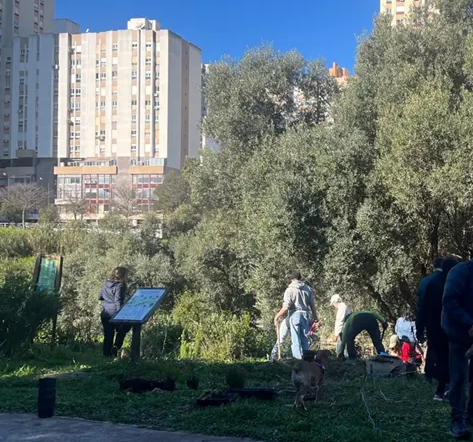
Volunteers planting in one of the URBEM tiny forests in Lisbon. Source: author’s own collection.
The city is finite: renegotiating space, making values explicit
Green corridors, rain gardens, and river renaturalisation all require space currently used for other purposes. In Lisbon, as in most consolidated European cities, that means space for cars. The Green Corridors of Lisbon, the result of a long-term collective effort, confront this reality in each intervention. The case of the Vale de Alcântara Green Corridor clearly illustrates these tensions, as conflicting visions for the future of Avenida de Ceuta expose how difficult it is to negotiate spatial priorities and create space for nature in the city.
The question is not whether cars belong in the city, but how much space we are willing to give up as other needs become pressing. NBS projects often try to avoid this discussion by fitting interventions into leftover spaces. When the renegotiation of road space becomes unavoidable, it tends to appear late and generate conflict. Disputes over square metres are disputes over values that planning doesn’t name directly. Fast individual mobility versus the possibility of staying. Privatised space versus collective space. Urban planning depoliticises these choices, yet they are decisions between different forms of urban life. What would change if we named them as such?
Who makes urban nature happen?
If implementing NBS requires this difficult renegotiation, who actually does this work? Something stood out in the field across both municipal-led and community-led projects: the amount of invisible work sustaining them. People within and beyond public institutions do far more than what is formally expected.
Tiny forests led by URBEM and initiatives such as HortaFCUL and Changing (H)earth depend on this effort. Convincing neighbours and institutions, mediating between municipal departments that do not communicate, persisting when funding runs out or political will fades, building consensus where there is distrust, navigating across levels of government, and bridging technical and local knowledge.
This work of mediation is also a work of care. I encountered people who know every tree that has been planted, who follow the development of NBS with a strong sense of personal responsibility, and who sustain projects with genuine commitment that goes far beyond contractual obligations. This work is political because it mediates conflicting values, but it is also deeply relational. As many interviewees noted, this work is often informal, underpaid, and absent from official reports. Without it, most interventions would simply not happen.
What We Need to Acknowledge
The material struggle over urban space and the invisible work of care reveal the same underlying issue. Conventional planning still struggles to articulate conflicting values. We treat as technical what is political and as voluntary what is essential. Making space for nature in cities means making collective priorities explicit, recognising that space is finite and choices are unavoidable, and valuing the relational work that sustains urban transformation.
What changes when we name these values explicitly? What changes when we recognise that space is finite and renegotiation is unavoidable, and that someone must do this work of mediation and that work deserves recognition? Recognising a plurality of values is a first step. Achieving transformation requires going further. We need institutional conditions that allow this plurality to shape decisions about urban space, and we need to recognise the work — technical, political, affective — that makes these transformations possible.
Failing to name these dynamics means continuing to render invisible both the political choices at stake and the work that sustains the transformation we claim to pursue.
Author: Andresa Lêdo Marques
Andresa is a Brazilian architect and urban planner. She is a postdoctoral researcher at the University of Lisbon, working on the NATURESCAPES project. Her research examines how urban planning integrates nature and how different values shape planning decisions. In her spare time, she enjoys exploring urban green spaces, cooking, and spending time with her family.
More reads
The work of Lisboa Possível, which draws inspiration from Barcelona’s Superilles (Superblocks) to reimagine Lisbon’s streets by reducing car space and creating more room for people and nature: https://lisboapossivel.pt/superbairro_misericordia
Barcelona’s Superblocks and how they have transformed urban space: https://www.citiesforum.org/news/superblock-superilla-barcelona-a-city-redefined/
The greening of public spaces in Paris: https://www.createstreets.com/reclaiming-the-city-how-paris-is-transforming-public-space-through-pedestrianization-and-greening/