

Nature-based solutions are often promoted as a way to create greener, healthier cities. Yet when biodiversity becomes a secondary outcome, we risk producing lush but ecologically empty spaces. To meaningfully address biodiversity loss, urban planning must move beyond human-centred greening and recognise cities as shared multispecies habitats.
During my field research in Gothenburg for the Naturescapes project, and while writing my master’s thesis on more-than-human planning in Sweden, it became clear that most nature-based solutions are primarily designed for human benefit, and biodiversity is often framed as a welcome side effect rather than a clearly articulated goal.
While this may seem logical (after all, cities are built for humans), it is also limiting. Increased greenery does not automatically lead to richer biodiversity. If the same plant species are repeatedly chosen for their shading capacity, resilience, or ease of maintenance, urban landscapes become increasingly homogenous. Over time, this undermines ecological diversity and resilience. Cities are mosaics of habitats and need to be acknowledged and supported as such.
To address biodiversity loss, we need to rethink how cities are planned and managed. This blog post builds on two key ideas. First, that urban biodiversity matters not only because it underpins ecosystem services, but because humans exist within a web of relationships with other species. Protecting non-human life is therefore a moral and political issue, not just a technical one. Second, that addressing biodiversity loss requires a shift in perspective: we must de-centre humans and adopt a more-than-human approach to urban planning.
I use wildlife as an entry point into this discussion. While more-than-human thinking extends beyond animals [1], wildlife offers a tangible way to explore what coexistence might look like in practice.
Why “Greening” Cities is Not Enough: Toward Care and Coexistence with Urban Wildlife
Wildlife as city dwellers
Humans do not live alone in the cities we build. Wild animals are deeply affected by urban development, yet they receive little attention in planning practice and research. As urbanisation encroaches on rural habitats, densification reduces green space, and buildings without the nooks and crannies needed for nesting and resting are built, animals are pushed out of both countryside and city.
Animals do not confine themselves to what we label as “nature,” such as parks or reserves. Cities themselves are made of natural materials, and animals live their lives on rooftops, in courtyards, attics, and underground infrastructure. Still, the persistent belief that cities and nature are separate makes wildlife largely invisible in urban settings, even as animals face threats from traffic, habitat fragmentation, and barriers such as roads and buildings.
Recognising animals as co-inhabitants is a crucial step toward designing cities that truly support more-than-human life.
De-centring the human
A key aspect of more-than-human thinking is de-centring the human. This does not mean prioritising other species over human needs but acknowledging that urban decisions inevitably affect other beings and ecosystems. Coexistence requires moving beyond viewing nature as a resource (or, as often is the case, a nuisance) and instead seeing it as a network of relationships of which we are a part.
Wild animals are often perceived as problematic when they cause inconvenience. Species that are labelled as pests or considered “out of place” are routinely removed, often through lethal control. Urban lifestyles and generational shifts have also increased physical and emotional distance from wildlife, making ordinary animal behaviour seem threatening or irritating.
This has become particularly visible to me since moving to an inner-city neighbourhood in my mid-sized Swedish hometown. The area is built around large courtyards with highly uniform greenery. Pollination sources are limited and few plants produce berries or seeds. Despite this rather sterile setting, feeding birds is considered inappropriate and is often forbidden in housing cooperatives. The stated reasons include bird droppings, concerns about disease, and the risk of property damage from mice and rats.
These arguments are typically presented with little room for nuance. Swedish rats, for example, carry a relatively low risk of disease (although such risks should not be dismissed entirely). It is also unlikely that a single, well-designed and well-maintained bird feeder in a 100 square-meter courtyard would lead to an explosion in the local rat population. If a rat or two appear, they most likely already live in the area but have simply kept themselves out of sight. Rats also perform largely invisible waste work for us [2] — but I digress. . .
While it is understandable that housing association boards want to make life as simple as possible for themselves and their residents, such blanket prohibitions are deeply unempathetic and may even encourage riskier forms of informal feeding. Alternatives could include shared feeders, coordinated management, or planting vegetation that provides food and shelter year-round. Such measures do not need to be complicated, but they do require openness to coexistence.
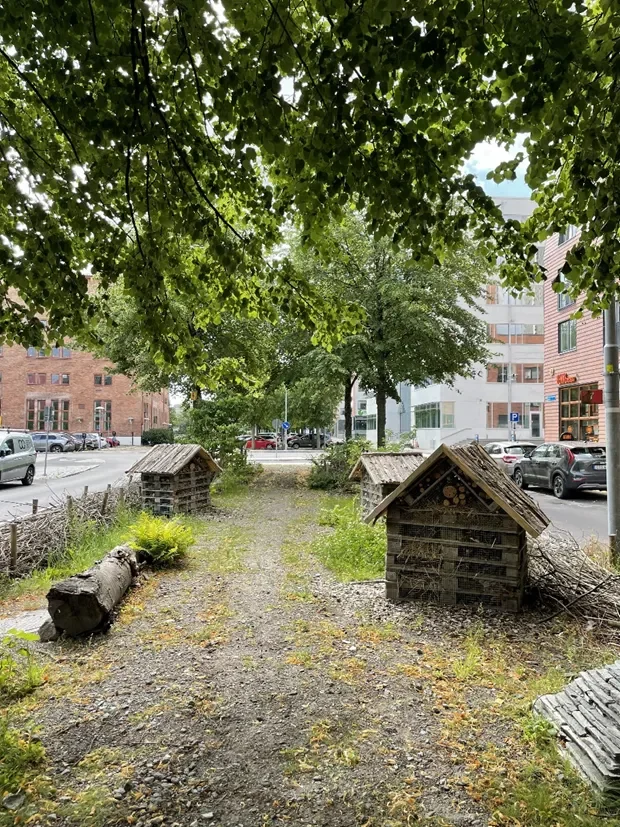
In the area of Lindholmshamnen in Gothenburg, a “biotope safety island” has been created to mimic an edge zone toward the forest. It is designed as a space for animals, plants, and fungi.
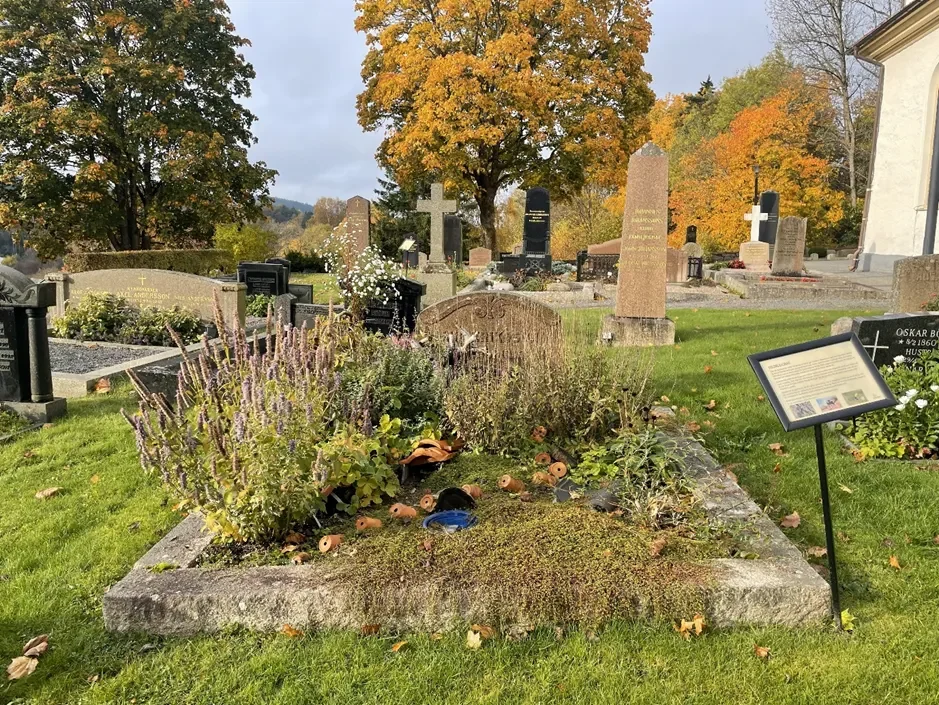
In Härryda, about 20 kilometres east of central Gothenburg, the local cemetery has incorporated themed graves for butterflies, bumblebees, and hedgehogs, transforming a site of remembrance into one that also includes ecological care. This is the bumblebee grave.
Toward multispecies urban futures
Planning for wildlife does not always require large-scale transformation. Small, targeted interventions such as species-specific design elements, adjusted maintenance routines, or better integration of ecological knowledge, can make a significant difference. What is missing is not examples, but systematic approaches.
As urban dwellers lose everyday contact with other species, empathy and care weaken. Planning that makes multispecies life visible can strengthen both ecological resilience and social connection. Coexistence will always involve negotiation, but creating cities where wild animals can live and thrive is both an ethical and practical project.
Ultimately, reimagining cities as multispecies communities requires more than technical fixes. It demands new ways of thinking, planning, and speaking about urban life. Words shape worlds, and by expanding the language of planning to include non-human lives, we open space for more caring, resilient, and ecologically alive cities.
This was not a blog post about rats, but when discussing human-animal relations, rats are an incredibly interesting case study worthy looking into. See, for instance, Tora Holmberg’s short paper on “wastable” urban animals or Tobias Linné’s Conversation piece on rats for more empathetic portrayals than in the mainstream discourse.
Including wild animals in urban planning does not always require large-scale transformations. Many species already thrive in cities but may need small adjustments or targeted support. Swedish landscape architecture office Urbio illustrates how specific focus species can be considered in urban design in their report Stadsbiotoper (“City Biotopes”, in Swedish). One example is the “berry aviary”, which offers house sparrows food, shelter and nesting opportunities in otherwise open and inhospitable spaces. Other examples of more-than-human urban design that I enjoy include Animal-Aided Design and this academic article on everyday nature.

Author: Lovisa Carli
Lovisa is a research assistant for Naturescapes and an urban planner. She has a strong interest in how urban planning can intentionally recognise and support more-than-human life while advancing social equity. In her spare time, she enjoys working with her hands (usually tending to her allotment or knitting sweaters), engaging in local politics and petting her three cats.
More reads
[1] Celermajer, D., Schlosberg, D., Rickards, L., Stewart-Harawira, M., Thaler, M., Tschakert, P., Verlie, B., & Winter, C. (2021). Multispecies justice: theories, challenges, and a research agenda for environmental politics. Environmental politics, 30(1–2), 119–140.
[2] Hohti, R., Tuominen, P., Aivelo, T., Simonen, M., Tammi, T., & Rautio, P. (2025). ‘This place cannot be tidied up! ’Stigmatisation, rats, and place-making in a multispecies city. Children’s Geographies, 23(5), 653–669.