

Imaginaries Typology
Imagining cities in harmony with nature: Diversifying imaginaries to deliver on GBF Targets 12 & 14.
Key Messages
Premise: Every urban greening decision under GBF Targets 12 and 14 rests on assumptions about what nature is for: cooling streets, raising property values, protecting species, or offering recreation and refuge from heat. These ideas, which we call urban nature imaginaries, are rarely stated, ye t they decide which problems get noticed, whose values count, which interventions seem legitimate, and who holds planning authority.
1. Unexamined imaginaries are a delivery risk for GBF Targets 12 and 14.
When one view of urban nature goes unquestioned, plans may add green space while overlooking biodiversity quality, ecological connectivity, equitable access or the multiple values of nature. This can weaken delivery of GBF Target 12 and the integration of biodiversity and its multiple values required by Target 14.
2. A five-step imaginaries scan to see what a plan might be taking for granted.
Our typology of 12 urban nature imaginaries helps policymakers and practitioners identify what a strategy, project or consultation may be taking for granted: what nature is understood to be for, whose values or knowledge are missing, and which alternative futures could be brought into view.
3. Surfacing diversity and disagreement early can support fairer and better-informed decisions.
Imaginaries are contested and change over time, and each brings its own tradeoffs and synergies. Making complementary and competing visions explicit before priorities, budgets and designs are fixed supports more transparent dialogue, better-informed trade-offs and more biodiversity-positive, equitable urban action.
Download and check out the 4-page Policy Brief.
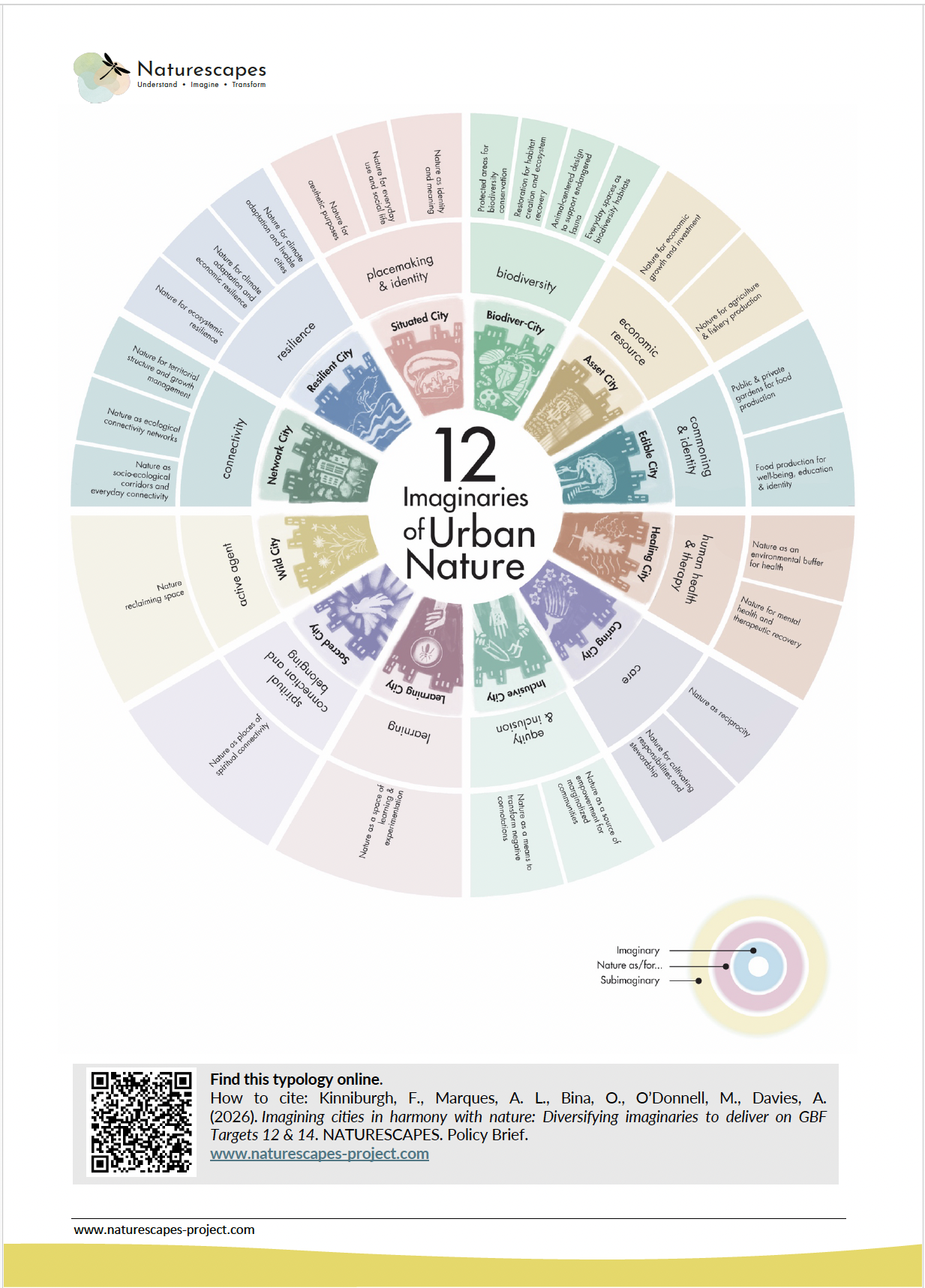
See the full Typology of Imaginaries and Sub-imaginaries.
Methodological note
This brief draws on comparative research in 12 functional urban areas (FUAs) across Europe, the United States and Latin America: Berlin, Cagliari, Cartagena, Detroit, Dublin, Fort-de-France, Gothenburg, Iași, Lima, Lisbon, Mobile and Phoenix. Case selection foregrounded exposure to environmental risks, inequality and socio-economic disadvantage. Further information is available on the project’s case-study webpage: naturescapes-project
The analysis brings together two complementary sources of evidence: municipal planning documents (master or general plans, climate plans and green or biodiversity plans) and research on 71 nature-based solution (NBS) projects, based on case study reports prepared using a common methodological protocol, drawing on participant observation and interviews with project developers, managers, volunteers and users during case study fieldwork.
We examined how urban nature is framed, the purposes assigned to it and the values foregrounded in policies and interventions. Value mapping was based on the Nature Futures Framework (IPBES, 2022; Pereira et al., 2020), considering intrinsic, instrumental and relational values and the overlaps between them. The resulting typology offers a non-exhaustive set of urban nature imaginaries and sub-imaginaries: analytical lenses that may overlap, complement or compete in practice, rather than fixed categories.
For more information about the research, contact our team.
Key references
IPBES (2022) Methodological assessment report on the diverse values and valuation of nature of the Intergovernmental Science-Policy Platform on Biodiversity and Ecosystem Services. Edited by P. Balvanera, U. Pascual, M. Christie, B. Baptiste and D. González-Jiménez. Bonn: IPBES Secretariat. Available at: https://doi.org/10.5281/zenodo.6522522.
Pereira, L.M. et al. (2020) ‘Developing multiscale and integrative nature–people scenarios using the Nature Futures Framework’, People and Nature, 2(4), pp. 1172–1195. Available at: https://doi.org/10.1002/pan3.10146